


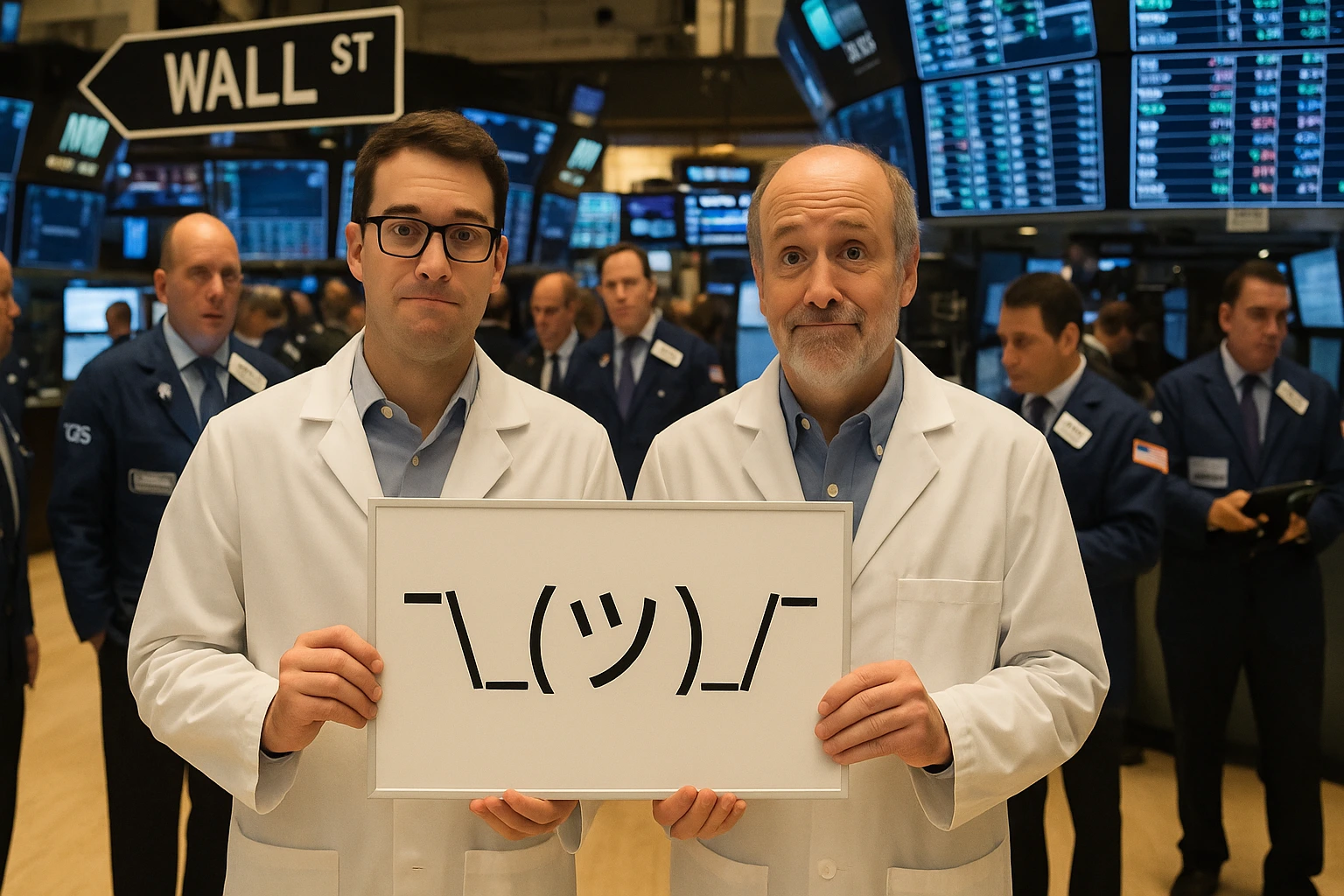
In a shocking yet strangely comforting revelation this week, a coalition of top global economists held a joint press conference to admit that, for the past several decades, they’ve been “basically guessing” about how the economy works.
“We were using graphs, jargon, and a lot of confidence,” said Dr. Leonard Fisbee, Senior Economist at the World Financial Institute, while shrugging apologetically. “But at some point, we realized the stock market was doing whatever it wanted anyway. So, yeah… we’ve just been winging it.”
The revelation sent Wall Street into an ecstatic frenzy. The Dow Jones surged 3,000 points within hours, Bitcoin hit a new all-time high “for reasons no one understands,” and the NASDAQ briefly renamed itself “The Wild West.”
Traders on the floor of the New York Stock Exchange were reportedly cheering, weeping, and fist-pumping as news of the economists’ honesty broke.
“Finally!” shouted one day trader dressed entirely in Patagonia fleece. “At last someone admits they don’t know what’s going on! That’s the transparency we’ve been waiting for. BUY EVERYTHING!”
“Our Models Were Just Vibes”
According to the 486-page report released by the consortium, the majority of economic models since the 1980s have relied heavily on “vibes, caffeine, and Excel formulas someone found on Reddit.”
“Most of our predictions were just copy-pasted from last year’s forecast,” confessed Dr. Marianne Closter of the Bank of England. “Sometimes we’d add a percentage point or two, depending on how confident we felt that morning. If we wore our lucky ties, we’d predict growth.”
The group also admitted that inflation targets, interest rate decisions, and GDP forecasts were often decided during “power lunches involving too much rosé.”
Despite the revelations, markets worldwide rallied in support of what investors are calling “radical honesty economics.”
“This is the kind of certainty we can finally trust,” said one hedge fund manager while buying a literal hedge “just to be safe.” “At least now we know everyone’s clueless. That’s something we can price in.”
Central Banks Issue New “Whatever Happens” Policy
In response to the press conference, several central banks have already adopted new monetary strategies.
The U.S. Federal Reserve announced its new “Just Let It Happen” interest rate policy, which will allow rates to fluctuate based on how Chair Jerome Powell “feels in his gut.” The European Central Bank is reportedly considering pegging the Euro to “the collective mood of the continent.”
Meanwhile, Australia’s Reserve Bank issued a statement saying it will now make policy decisions by spinning a wheel with sections labeled “Raise,” “Lower,” and “Ask the Koalas.”
Economists Finally Find a Use for Astrology
In a follow-up announcement, the economists’ coalition confirmed it will now incorporate astrology, tarot, and TikTok trend analysis into its forecasting models.
“Honestly, Mercury retrograde has been more accurate than our inflation predictions,” said Fisbee. “We’ve hired a team of influencers to interpret lunar cycles for market movements. We’re calling it The Bloomberg Horoscope Index.”
Investors have already embraced the shift. Major hedge funds are now hiring professional astrologers, and CNBC has added a new morning segment titled “Mad Mars with Jim Cramer.”
A New Era of Confidence
When asked if they feared losing credibility, the economists laughed.
“Lose credibility? That assumes we had any left!” said Dr. Closter, beaming. “This is a win-win. We admit the truth, markets go up, and we get to stop pretending we understand derivatives. Everyone’s happy.”
At press time, the stock market had reached a record high for the third consecutive day, buoyed by what analysts are calling “a collective sense of relief that everyone was faking it all along.”
As one jubilant investor put it:
“The world economy finally makes sense—because it doesn’t make any sense at all.”