


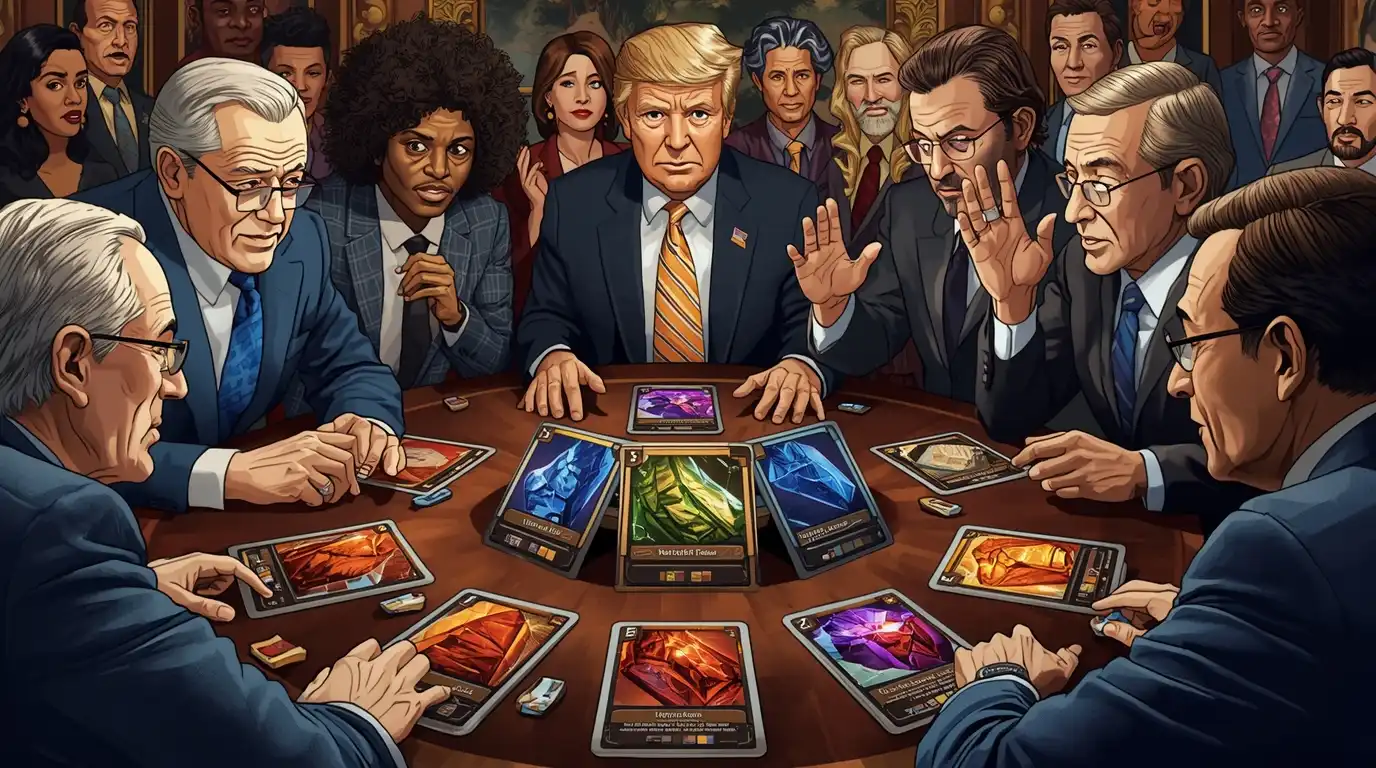
In a development that economists are calling “the logical next step in late-stage capitalism,” world leaders have officially begun trading critical minerals the same way children once swapped Pokémon cards behind school canteens.
The new Global Critical Minerals Trading Framework, introduced at this week’s G20 “Earthconomics” summit, has transformed international diplomacy into what experts describe as “a high-stakes nerd convention.” Instead of handshakes, presidents now greet each other by dramatically flipping laminated cards of lithium, nickel, and rare-earth elements across mahogany tables.
“It’s simple,” explained U.S. Secretary of Commerce Gina Raimondo, sliding a holographic ‘Rare Earth Bundle’ across to Japan’s trade minister. “If you want to build electric cars, you gotta collect ‘em all.”
“Energy Security, But Make It Collectible”
Each mineral now comes with its own trading card, complete with rarity rating, carbon footprint stats, and a “mining origin hologram” for authenticity. China reportedly holds the ultra-rare Rainbow Foil Dysprosium card, while Australia has cornered the market on limited-edition Lithium from Outback Dust Storm Variant.
The United States, lagging behind, has resorted to “booster packs” filled with speculative cards—like Alaska Graphite (Unconfirmed) and Wyoming Cobalt (Under Environmental Review) – which occasionally turn out to be just photos of rocks.
Meanwhile, the European Union has released its own expansion pack, “Green Deal 2.0,” where players can trade sustainability points to evolve their resources. France, unfortunately, drew three copies of “Bureaucratic Delay” and immediately had to skip a turn.
Diplomatic Showdowns
The new format has made global diplomacy far more entertaining, if not productive.
At a recent UN meeting, a tense standoff erupted when Canada attempted to trade its Ultra-Lithium Alberta GX card for Indonesia’s Cobalt Mines EX. Witnesses report that the room went silent before China dramatically placed down a Full-Art Graphite Monopoly and declared, “You triggered my supply chain trap card.”
Security intervened when the UK tried to “borrow” Australia’s nickel foil for “research purposes.” Australian Prime Minister Anthony Albanese reportedly replied, “Oi mate, you bent the corner. That’s worth half now.”
Black Markets & Bootlegs
The craze has already spawned a thriving black market. Shady dealers in Dubai and Singapore now sell “shiny graphite” fakes printed on recycled EV battery casings. One notorious seller on the dark web, known only as The Elementalist, was arrested after trying to pass off a tin-foil-wrapped pebble as “authentic gallium.”
Even Elon Musk has joined the frenzy, launching a limited NFT series called “Muskémon: Electric Vehicle Edition.” Each token represents a future promise of a mineral Tesla “might totally source ethically someday.” Prices start at $12,000 per NFT, batteries not included.
The Future of Trade
Economists warn that if the mania continues, children might soon abandon regular Pokémon entirely, demanding “Critical Minerals: The Card Game” for Christmas instead.
Parents are already complaining. “My son just traded his entire Charizard deck for a single rare ‘Indonesian Nickel GX’ card,” said one distraught mother. “He says it’s ‘the future of electrification.’ I say it’s a shiny piece of dirt.”
Meanwhile, the International Monetary Fund has announced plans for an official Mineral Index, measuring a country’s GDP not in dollars, but in foil density.
If all goes according to plan, world peace could soon be achieved through trade—not of ideas, but of minerals. As UN Secretary-General António Guterres sighed at the closing ceremony:
“At least they’re not throwing sanctions this time. Just cards.”