


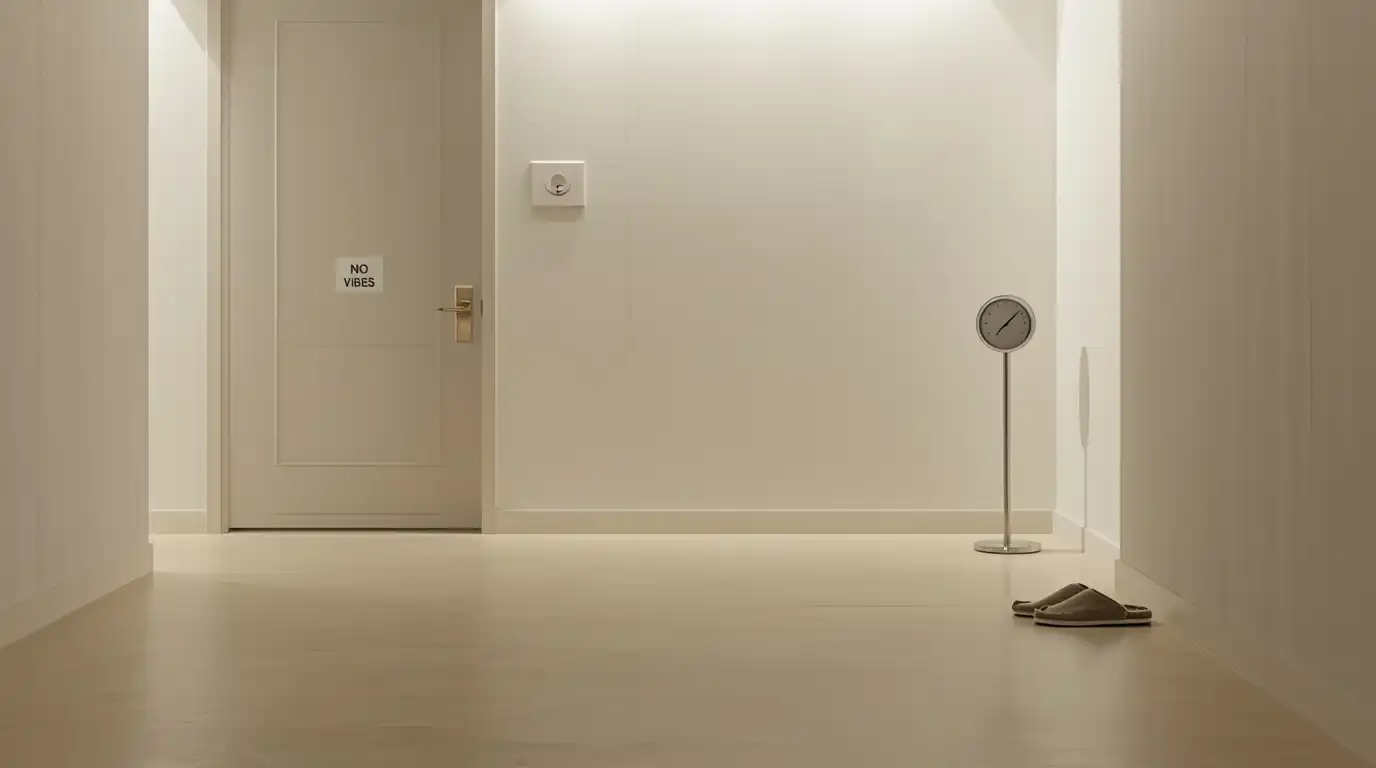
Tourism officials in Tokyo have unveiled a radical new attraction aimed at overtourism, burnout, and the international compulsion to hold your phone like it owes you money: a room with absolutely nothing in it.
Nothing to photograph. Nothing to review. Nothing to “go viral.” Not even tasteful minimalism—just legal emptiness.
The “Mu Room” (from mu, meaning “not, nothingness”) is housed inside a former department store floor near Shinjuku Station. Guests are asked to deposit their phones into velvet-lined lockers labeled “Ego,” “Brand,” and “For The Plot.” A small sign announces the house rules: “No talking. No clapping. No vibes.” Staff members—described in press materials as “Silence Rangers”—glide about in tabi socks to ensure compliance and confiscate any statements that begin with “As a content creator—”.
“Japan welcomes visitors,” said a Tourism Agency spokesperson at the whisper-only press conference, “but there are places where our cultural heritage is strained. We’ve tried arrows on footpaths, selfie bans at temples, and QR codes with polite cartoons. Now we offer the one experience influencers cannot weaponize: nothing.” He bowed, then bowed again to the decibel meter, which chirped approvingly at 23 dB and posted nothing about it.
Visitors purchase timed-entry tickets for fifteen-minute intervals, priced at ¥1,800 for General Nothing, ¥3,200 for Deep Nothing (includes complimentary earplugs), and ¥5,000 for Nothing Plus, which comes with a staff member gently reminding you that your worth is not contingent on engagement metrics. Those needing extra help can rent “Thought Dampeners,” which are like noise-canceling headphones but for opinions.
Inside, the room is 15 meters of blank floor, a wall of unpainted plaster, and—critics claim—an air of judgment from no one. Still, reviews are pouring in, despite the attraction’s strict “no reviews” policy.
“I stood there and felt the absence of FOMO reach into my mitochondria,” murmured a Canadian visitor, outside, because interviews inside are prohibited. “It was like a spiritual buffering wheel.” He later reported purchasing an empty tote bag from the silent gift shop. The shop’s shelves are unstocked and every item is labeled “Out of Nothing,” priced at ¥2,200.
Not everyone is thrilled. A travel YouTuber attempted to film herself “experiencing the void” using a chest-mounted camera. She emerged weeping, insisting the footage was “just a rectangle.” Her management has since announced a pivot to “long-form descriptions of gaps.”
Elsewhere in the city, local residents are cautiously optimistic. “If people can queue for nothing, maybe they will stop queuing for everything,” said a barista near Harajuku, gesturing at a line wrapped twice around a shop selling clouds on sticks. A monk in Asakusa was reportedly seen smiling for the first time since 2015, though he denies it.
In policy circles, the Mu Room is being hailed as a breakthrough in tourism management. Pilot programs in Kyoto nearly reduced foot traffic around popular shrines by redirecting visitors to an empty carpark with a rope. A senior planner explained the logic: “Tourists crave exclusivity. What’s more exclusive than content the internet can’t metabolize? If everyone has the same photo of the Torii gate, no one has the one photo of nothing.” The planner then sold a limited-edition commemorative blank postcard that instantly sold out and cannot be resold because it is indistinguishable from printer paper.
Environmentalists have chimed in, too, estimating the Mu Room will reduce the carbon footprint of vacation photo storage by roughly a fjord per fiscal year. “Not photographing things is the new recycling,” claimed one NGO, unveiling a campaign: Skip the Snap, Save the Planet.
Naturally, a controversy has emerged: tech companies are demanding access to “train AI on the absence.” Japan’s Data Protection Commission issued a terse memo: “There is no dataset.” An AI executive countered: “Exactly.”
Still, the attraction has teed up a slew of derivatives. A Tokyo hotel is testing “Blank Window Views”—curtains facing a wall. A Michelin-starred restaurant has launched a “Silent Tasting Menu” consisting of 12 courses of aroma. And a rail operator announced a “Non-Scenic Route” in which every carriage window is frosted to “protect passengers from the menace of landscapes.”
UNESCO, not to be outdone, has reportedly “taken note” of the initiative, hinting that “intangible world heritage” may soon include a category for “mutual silence in the presence of nothing in particular.”
For now, demand is ferocious. Early access tickets vanished in 40 seconds, which is a long time in 2025. A black-market “Mu Resale” channel briefly sprung up, but buyers demanded proof they had purchased nothing and were satisfied when sellers provided it.
Back in the room, a small floor plaque reads: “You are not missing anything.” It’s unclear whether the message is comforting or seditious. Either way, nobody took a photo of it—and that, officials say, is the point.