


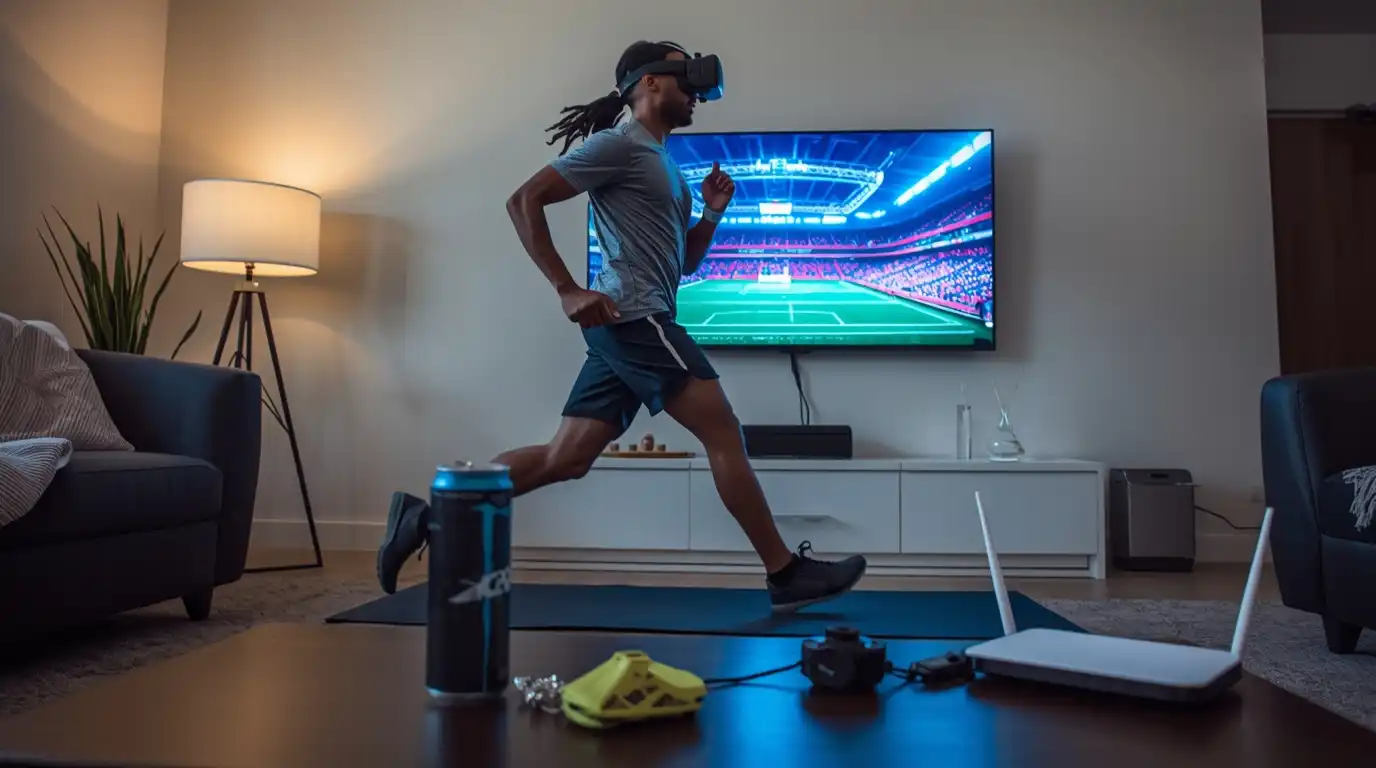
Doha, Qatar — In a landmark decision that definitely isn’t about selling virtual luxury boxes, FIFA today announced the next World Cup will be played entirely in the metaverse “to save grass.” Players will compete from their home gyms wearing VR headsets, referees will be replaced by AI that only accepts crypto bribes, and stadium “attendance” will be capped at 12,000 Wi-Fi routers for “safety and vibes.”
Officials in Doha say this bold step will “protect every blade of grass on Earth,” which is convenient, because none of them exist in the virtual stadium. “We’re proud to pioneer carbon-neutral nutmegs,” said a spokesperson, gently polishing a headset labelled Eco Mode. “Our players will sprint in place, our fans will buffer responsibly, and our security will be state-of-the-art password hints.”
The athletes, meanwhile, are adjusting to the new reality of competing on a rug next to a stationary bike. The home-gym mandate promises fewer injuries and more awkward furniture. “You can’t pull a hammy if your legs are technically software,” said “experts,” who appeared to be a slide deck.
Refereeing will be overseen by an AI system that according to its whitepaper, only accepts crypto bribes. (Sustainability note: it prefers proof-of-stake, because even corruption needs to be energy-efficient.) In testing, the model issued five red cards and then purchased a cartoon llama. “Transparency is vital,” a tech consultant explained. “All decisions will be recorded on-chain, where no one will read them.”
Ticketing is also evolving. With stadium attendance limited to 12,000 Wi-Fi routers, fans will queue for the coveted SSIDs: Qatar_Arena_5G, DohaGuest-Extender, and the exclusive VIP-Mesh-Platinum (Password: $$$$). Concession stands will offer downloadable pies, which pair beautifully with a lag spike.
Doha’s PR machine calls it a “win-win-win”: no mowing, no travel, no grassroots protests—because nobody has legs. “It’s about ethics and ecology,” said one official, before clarifying that the “Save Grass” campaign refers to turf and not any other herbaceous debates. (Legal said to include that sentence.)
Players are surprisingly upbeat. “I can finally host a World Cup and babysit at the same time,” said one veteran, adjusting their headset while warming up between a laundry basket and a motivational poster. “Also, my dog is our 12th man now, which feels right.”
There are teething issues. In early friendlies, several teams lost 3–0 after a nation-wide outage forced everyone to play in slideshow mode. One very tired commuter claimed he watched an entire penalty shootout on the train, except it was just the loading wheel making all the saves. FIFA insists the technology will be “seamless by kickoff”—a phrase historically used moments before a software patch.
For authenticity, the metaverse stadium includes wind you can hear but not feel, a goal smell DLC, and dynamic booing you can mute for an extra fee. (Parental control: “Reduce Shrieking” slider, 0–10.) And yes, there will be VAR—rebranded as “VR-VAR,” a system that reviews itself and still gets it spectacularly wrong, but now in 8K.
The environmental maths remain hazy, but the messaging is flawless: greener than green, cleaner than clean, and sponsored by three different banks. The final will be held at midnight local time, or whatever time your router thinks is meaningful.
The beautiful game has entered its “don’t touch the grass” era, because the grass has a lawyer.